








































Industrial requirements for EMI filters and Power Supplies
Components for industrial applications (such as EMI FILTERS and power supplies) require requirements that are very different from all other fields (for example for THREE-PHASE mains). The demand for customized products is growing strongly and the market requires significant and rapid adaptations to industry. This is why it is essential to identify the EMI filters/mains filters/line noise filters and POWER SUPPLIES best suited to the needs of industrial applications, such as motors, power conversion, rectifiers, inductive circuits, testing, automation and assembly.
Industrial applications requiring high power are often supplied by a THREE-PHASE mains (or with more than one phase), in order to distribute the power across multiple phases and optimize current draw. The THREE-PHASE system consists of three conductors for alternating current, usually identified as A, B and C. The three phases work at the same frequency and voltage, but are offset by 120°, allowing constant power transfer within the electrical cycle.
THREE-PHASE mains are particularly important because they allow 3 times the power to be transported using only 1.5-2 times more cable compared to a SINGLE-PHASE system, simplifying, for example, motor design by eliminating starting capacitors.
Why use an EMI FILTER/ mains filter?
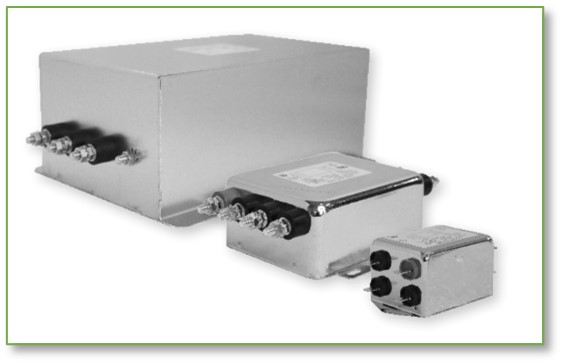
Despite the numerous advantages, power conversion via THREE-PHASE systems (Inverters, Rectifiers) generates high-frequency disturbances.
EMI filters attenuate the high-frequency noise generated by industrial devices, both by removing its component from Line and Neutral, and by routing it to Ground. EMI filters / line noise filters in industrial settings are very effective when EMI disturbances are generated in the frequency range from 9 KHz to 30MHz. EMI above 30 MHz can travel through the air, so both shielding and input/output insulation become necessary.
Three-phase: DELTA vs WYE – Brief explanation
To maintain optimal load distribution, three-phase systems can be configured in 2 ways: DELTA and WYE, which define how the cables are connected to each other.
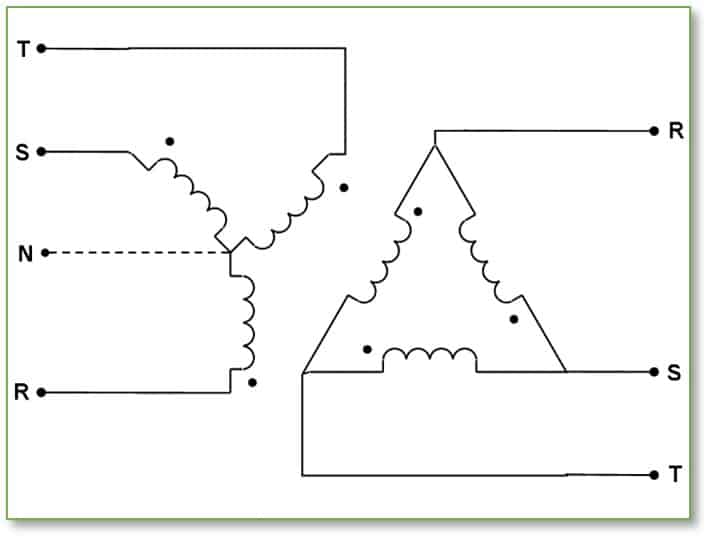
DELTA comes from the Greek symbol “Δ”, while WYE recalls the letter “Y” and is also known as a star circuit. The difference between the 2 configurations lies in the number of cables, and the increasingly used WYE has a NEUTRAL cable, allowing both LINE-PHASE (single-phase) and LINE-LINE (2 or 3 phase) connections.
DELTA CONFIGURATION
The DELTA configuration is made up of 4 conductors, connected to each other to form a closed triangular circuit, without NEUTRAL. The DELTA configuration is used to cut costs, since it needs one fewer conductor, and for applications requiring high starting torque.
In the figure above, the WYE diagram is on the left and the DELTA one on the right.
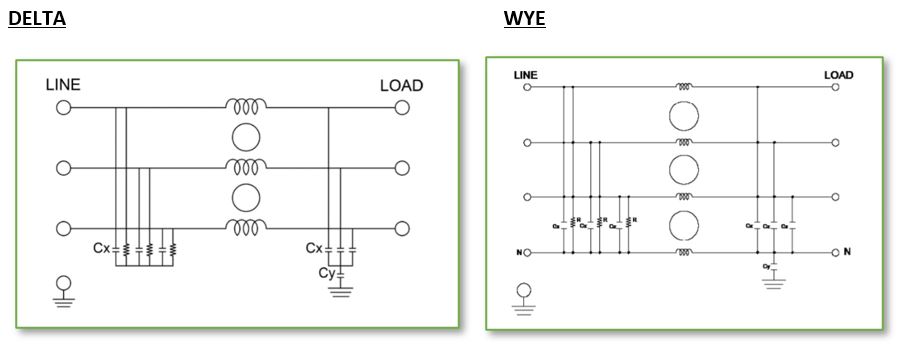
Given the absence of neutral, the capacitors in filters for DELTA networks must be chosen for the voltages generated LINE-LINE, therefore with greater size, weight and cost. However, the absence of neutral allows higher currents than WYE networks and better performance for the same volume.
WYE CONFIGURATION
WYE network filters are usually designed to filter power conversion switching devices and other devices that require neutral, bringing this configuration to 5 conductors (3 phase, neutral, ground).
When the 3 phases are perfectly balanced, no current flows through the neutral conductor, while current is present in this conductor when imbalances occur. This configuration allows the use of lower-voltage capacitors in the filters (120Vac in 208Vac systems and 277Vac in 480Vac systems), leading to savings in cost, weight and volume.
The WYE network can be used both with and without neutral, but its main use is in power distribution both single-phase (line-neutral) and on 2-phase and 3-phase, but with lower inrush currents and trying to avoid any imbalances between phases. Furthermore, a WYE network can supply a DELTA network simply by omitting the NEUTRAL connection.
Filters for DC applications
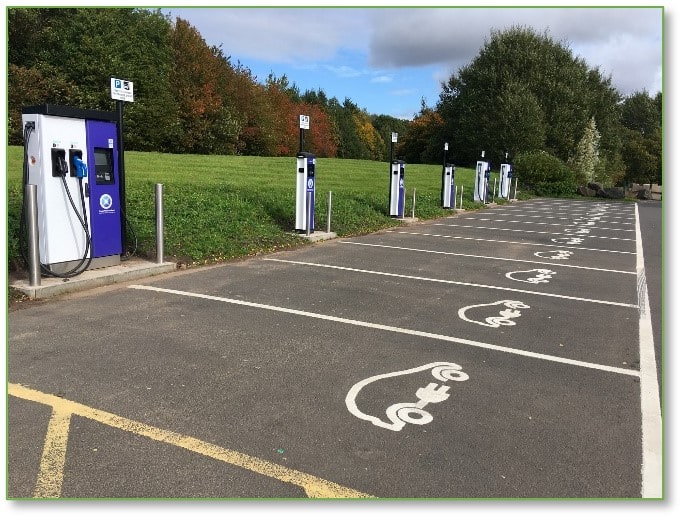
In the industrial field we find numerous applications with specific requirements, such as the need to filter
DC lines (inverters, EV chargers, aerospace, …).
In these cases there are dedicated EMI FILTERS capable of operating up to 1200Vdc, in single-stage and double-stage configurations with high attenuation.
Application examples and solutions for mains filter/line noise filter application
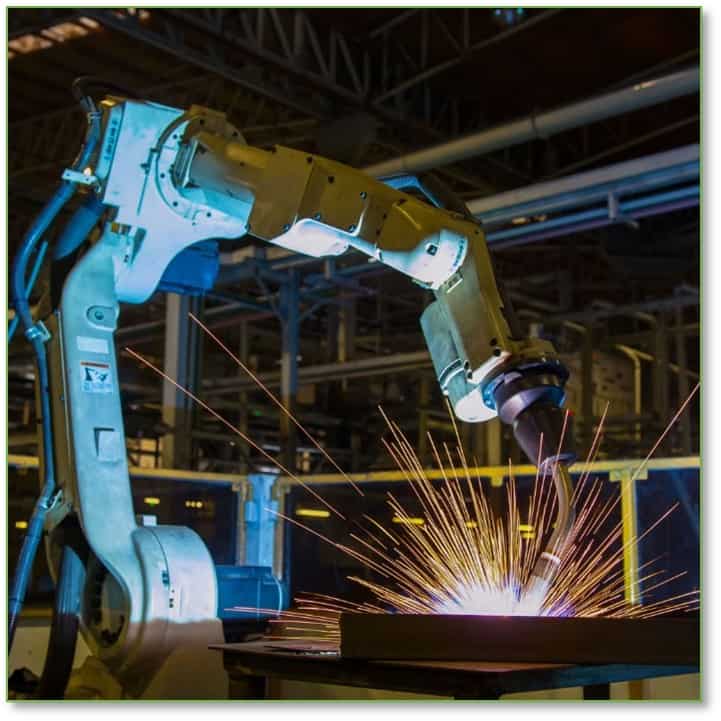
Here are some examples of industrial applications:
- Automation devices
- Variable frequency drives
- Motor control
- PWM circuits
- Welding equipment
- Transport and lifting
- Industrial heaters
- UPS
- Inverters
- Solar power generators
- EV / Battery chargers
- Ozone generators
- Laser sources
- Plasma sources
ASTRODYNE TDI solutions for EMI filters
Astrodyne TDI products, available in both single-stage and multi-stage versions, allow industrial devices to be fully compliant with the emission requirements set by international standards, with solutions from 1A up to 2500A and up to 600Vac/1200Vdc.
Astrodyne TDI’s range of EMI FILTERS allows you to choose the value of the Y capacitance (between L-N and Ground) to meet every requirement, both for leakage current and filtering attenuation.
Multiple solutions are also available, in terms of size and interconnection (for faston terminals, screws, studs, terminal blocks, cables, bus bars, etc.)