









































A change in the CE marking acquisition process is expected on December 20, 2020.
Until that date, if units subjected to testing pass the EN 60950-1 standard, they are presumed to comply with the LVD (Low Voltage Directive) 2014/35/EU, which ensures that electrical equipment within certain voltage limits provides a high level of protection for European citizens. This presumption will be withdrawn at the end of next year, to be replaced by the EN 62368-1 standard, so designers of equipment requiring the CE mark must specify power supplies that meet the new standard.
The IEC 62368-1 standard, Ed 1.0, was written in 2010 by IEC TC108, the technical committee that advises CENELEC, the European Committee for Electrotechnical Standardization, on safety standardization for AV, information, and communication equipment. Edition 2 was published in February 2014. The IEC (international) and EN (European) versions of the new standard are identical. It is currently a voluntary alternative to the IEC 60065-1 and IEC 60950-1 standards.
In December 2020 it will become mandatory as the only standard. The new standard was mainly driven by manufacturers of devices such as smartphones that combine processing, AV, and communication functions, previously covered by IEC 60065-1 and IEC 60950-1; however, the new standard, IEC 62368-1, is not a simple merger of IEC 60065-1 and IEC 60950-1.
The IEC 62368-1 standard covers equipment such as PCs, amplifiers, digital cameras, TVs, mobile phones, power supplies, network infrastructure equipment, battery-powered devices, photocopiers, and musical instruments. For the standard to cover all these different products, it must be technology-independent and more hazard-based or, in other words, it must be based on best engineering practices rather than product specifications. This results in a more performance-based approach, with products achieving qualification based on test results rather than construction regulations.
Each hazard proposition is individually defined, stating: the objective of the clause, the energy source, and the additional reinforced safety measures and location of the protection, including its properties and parameters. Finally, the safeguard tests to verify the mitigation of hazards.
Injuries occur only when the hazard (mainly electrical energy sources, but can be others such as heat, fuel, mechanical, radiation) has a mechanism that allows the transfer of significant energy for a significant time to the body. Energy sources are divided into three classes, as detailed in Table 1.
|
Energy source |
Effect on the body | Effect on combustible materials (fire ignition) |
| Class 1 | Not painful, but detectable | Ignition unlikely |
| Class 2 | Painful injury, but not permanent | Ignition possible, limited spread |
| Class 3 | Injury | Likely ignition, rapid fire spread |
Table 1: Energy source classes
A Class 1 energy source has levels not exceeding the Class 1 limits:
- normal operating conditions;
- abnormal operating conditions that do not result in a single fault condition;
- single fault conditions that do not result in exceeding the Class 2 limits. Under normal operating conditions and abnormal operating conditions, the energy in a Class 1 source, upon contact with a part of the body, may be detectable, but is not painful nor is it likely to cause injury.
A Class 2 energy source has levels that exceed the Class 1 limits and do not exceed the Class 2 limits:
- normal operating conditions,
- abnormal operating conditions,
- single fault conditions.
The energy in a Class 2 source, upon contact with a part of the body, may be painful, but is not likely to cause injury. In the event of fire, the energy in a Class 2 source may cause ignition under certain conditions.
A Class 3 energy source has levels that exceed the Class 2 limits:
- normal operating conditions,
- abnormal operating conditions,
- single fault conditions or any energy source declared as a Class 3 source.
The energy in a Class 3 source, upon contact with a part of the body, can cause injury. In the event of fire, the energy in a Class 3 source can cause ignition and flame propagation where fuel is available.
Safeguard measures are classified into three levels:
1) Basic protections: effective under normal and abnormal working conditions.
2) Supplementary safety measures: effective in the event of a single fault of any part, including basic safety protections
3) Reinforced protections: effective under normal and abnormal operating conditions and single fault conditions.
Each of these is classified as follows:
- Equipment protections: inherent to the product and not dependent on the user to implement or influence the effectiveness of such safeguards.
- Installation protection: the installer must be competent in installation (protection is achieved through correct installation).
- Behavioral protections: the energy source is accessible to the user
Table 2 explains the safeguard measures in more detail.
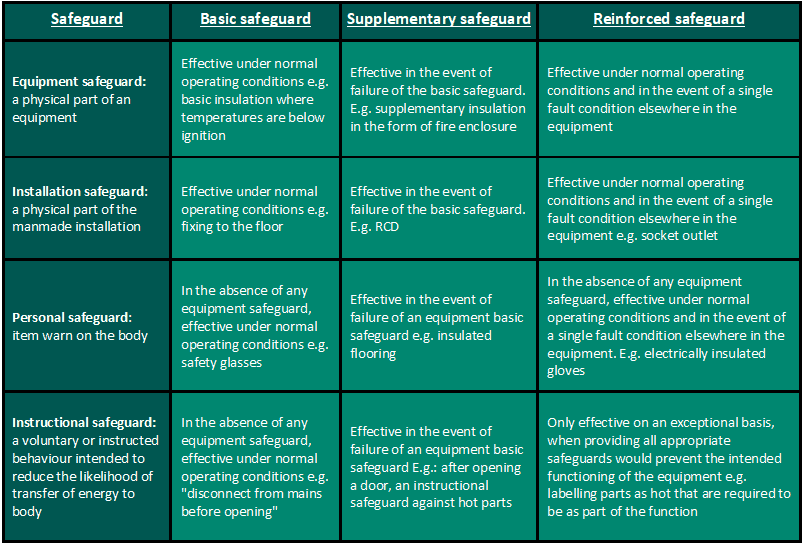
Table 2: Safeguard levels
How does the EN 62368-1 standard compare with EN 60950-1?
Most of the changes are descriptive, for example: SELV (Safety Extra Low-Voltage) and LCC (Limited Current Circuit) are covered by the Class I energy class. The TNV telephone network voltage is described as an external circuit. The service person becomes a qualified person and the user (operator)/limited-training user becomes, respectively, an ordinary person or an instructed person.
The planned change to the new standard will take effect on December 20, 2020. To facilitate the transition to the new standard, clause 4.1.1 has been added to the current revision 2 of the standard: “Application requirements and acceptance of materials, components, and subassemblies.” This essentially allows for the continued use of IEC 60950-1 components as part of the system, including chassis-mount and board-mount power converters. The current revision states that this will be removed in revision 3; however, the latest news from IEC TC108 is that they plan to keep the clause longer and that it will not be removed with revision 3 of the standard.
CONSYSTEM, a technical distributor of power supplies specialized in innovative solutions and new products for the benefit of system designers, is working to offer solutions suited and relevant to the various needs of the market.
All current ITE and industrial products will be updated or will already have the new certification, as will some products that have dual approval for medical applications; no one will have to face obsolescence due to the migration of regulations.