











































Over the last decade – in line with Moore’s Law – we have witnessed an exponential technological progress of the various embedded devices, which has increasingly favored the development of the IoT “phenomenon”: ever smaller sizes combined with greater interconnectivity and communication capability of devices.
The contribution of Bluetooth technology in this respect has been fundamental – especially since 2010 thanks to BLE (Bluetooth Low Energy) technology – and will be increasingly so in the future.
It is no coincidence that, with the arrival of the new versions of the Bluetooth standard, Bluetooth Low Energy is “setting the pace”, moving from applications historically focused on low-power sensors (designed to send small amounts of high-latency data, e.g. personal electronics and wearables) to other applications and actions related to engagement, location-based services, and localization (for multiple scenarios and environments such as: asset tracking or worker safety in factories, traceability and localization of patients or staff in hospitals, access authorization or restriction, etc.).
In light of this scenario, Consystem S.r.l. is “introducing” to the Italian market the new Bluetooth Low Energy module from High Flying Electronics Technology Co (a Hi-tech company specializing in the IoT field): HF-BL200A.
HF-BL200A: BLE module
The HF-BL200A module is a Bluetooth Low Energy (BLE) integrated circuit, designed to provide BLE connectivity to microcontrollers (MCUs) and “Host” systems, ensuring high stability in data transmission and communication, and guaranteeing maximum performance with minimal power consumption.
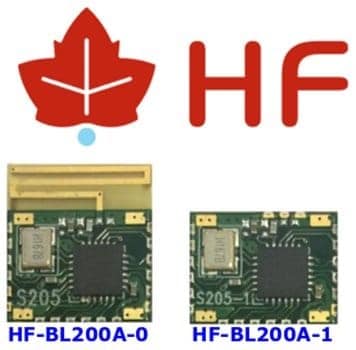
The HF-BL200A is a compact, fully integrated solution, consisting of a 2.4 GHz baseband radio transceiver for Bluetooth Smart®, a PHY modem, an internal microprocessor (MCU) with the BLE protocol, and a packet assembler/disassembler.
The module is built on a RISC 48MHz ARM M0 MCU architecture, capable of ensuring an optimal connection solution “for the various devices” (from wearables to other embedded applications, including in industrial settings) to the Bluetooth wireless network, and the subsequent data transmission via the physical UART (Universal Asynchronous Receiver-Transmitter) interface.
The extremely small dimensions (9.5mm x 12mm x 2mm in the external antenna version), and the anti-interference performance (which ensures high shielding), allow the module to be widely used in different environments and scenarios.
Power State
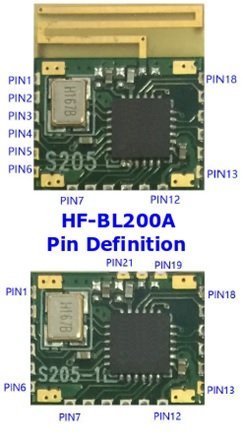
The HF-BL200A module is “characterized” by 4 power states: inactive, hibernation, sleep/suspend and active.
The different power states have different levels of consumption and related activity, as follows:
Inactive
all chip activities are stopped. This state is currently disabled by default.
Hibernation
32k RC (Run Current) as Real Time Clock (RTC).
Sleep/Suspend
32k RC (Run Current) as RTC, XTAL core running at low current for faster device startup.
Active
with the system active, it is possible to set the protocol and database parameters, run the BLE protocol and carry out RF (Radio Frequency) activity.
Transparent Transmit Mode
In this mode, the BL200A exchanges data bidirectionally with the remote terminal through the UART interface. The module parameters are programmed via AT commands, in particular the Bit Rate and the BLE Connect Interval.
It is recommended to use a bit rate of 115200bps when transmitting large amounts of data or when handling real-time applications.
The BL200A module has a default Connect Interval of 20ms, for compatibility with iOS systems, and can be varied between a minimum of 7.5ms and a maximum of 2000ms depending on the transmission speed and whenever it is necessary to reduce current consumption.
Hardware Versions
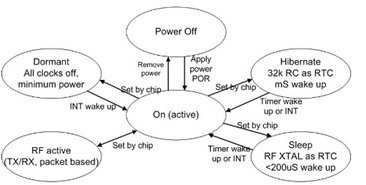
The BL200A module is supplied in two hardware configurations:
HF-BL200A-0: external pad antenna
HF-BL200A-1: internal PCB antenna
In short, the HF-BL200A modules are a compact and reliable solution, ideal for the many applications related to new BLE scenarios.
See other products for IoT here