











































Computer On Module: improving the security and reliability of COM module-based designs
The COM (Computer On Module) form factor is by far the most widely adopted for equipment used in the military, transportation, medical, entertainment, networking and industrial sectors. The widespread adoption of COM modules is the result of the many advantages their use brings, including the ability to develop embedded systems in shorter timeframes, reduced risks and costs, and broad customization freedom. The use of a standardized form factor also simplifies the upgrade or replacement of technologies on backplanes and carrier boards.
Due to the small footprint of standard COM modules, manufacturers of these modules must necessarily choose compact solutions for data storage. A chip-level device, such as a BGA-packaged SSD (BGA SSD), is a decidedly interesting miniaturized solution but, in the past, the relatively high (and volatile) price of these SSDs discouraged manufacturers from using them. Many manufacturers therefore integrated a socket or added a connector for a CF (Compact Flash) or SD card to the set of functionalities running on the boot disk.

More recently, serious doubts have begun to emerge regarding the use of CF and SD cards in embedded systems. In several sectors – military, medical, automation, transportation and others – enormous investments are made in developing the software that runs on embedded systems. This means it is very costly to replace an existing COM board with a new design, because in the sectors just mentioned, product life cycles of 20 years (and even longer) are very common.
As a result, embedded system manufacturers pay great attention to longevity and data protection, adopting appropriate measures to counter any factor that could interfere with the integrity of data stored on a COM module. Not to mention the risk related to theft of residual data left in the buffer memory of devices being decommissioned. Attempts to address this risk by marking devices intended for disposal with a data protection warning have not produced the desired results. For this reason, the use of removable media such as CF and SD cards has been progressively declining.
At the same time, the cost per Gigabyte of NAND Flash storage devices has been steadily decreasing, making NAND-based storage technologies, such as BGA SSDs and eMMCs, much more attractive to COM module suppliers than before. Indeed, BGA-package and eMMC SSD storage devices are already used in the various formats adopted for embedded computing systems, including COM Express Basic, COM Express Compact, COM Express Mini, Qseven (Q7) and ETX. The growing demand for the latest computing technologies to run algorithms at the edge of the network (edge computing) in high-end industrial applications has increased demand for COM-HPC compliant devices, which can take advantage of high-performance SSD technology.
Sustained growth in demand for onboard BGA-package SSDs
Demand for integrated onboard BGA SSDs has thus grown to this day for various reasons. First, COM module suppliers have focused their attention on costs and the return on their technology investments. When SSD technology was first introduced to the market, the cost of SSD devices was relatively high: the price of a NAND Flash-based storage device could reach 40 dollars per Gigabyte. This price was also volatile due to fluctuations in the cost of NAND Flash. For this reason, suppliers were reluctant to integrate an SSD as the standard storage medium for the module board.
Over the years, the cost of NAND Flash has decreased exponentially, dropping to less than 1 dollar per Gigabyte. For this reason, the cost of a device such as a 32 GB SSD or an 8 GB NAND in SLC-mode technology has become affordable, encouraging manufacturers to integrate a BGA-package SSD into a COM board.
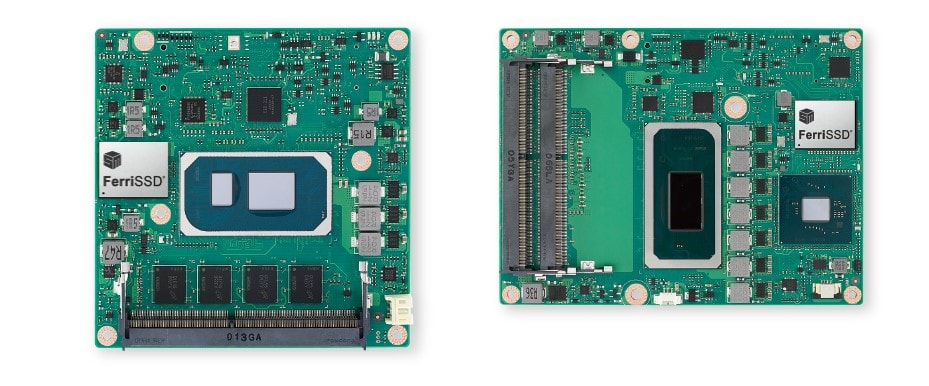
The other reason behind the growing demand for SSDs in the COM module market is customer demand. In industrial applications, for example, robust hardware and data protection are essential requirements. Since CF or SD cards can be easily removed, the personal data they contain is exposed to theft.
Equipment intended for use in military or industrial applications must also meet strict requirements in terms of tolerance to high temperatures, stress, vibration and other environmental factors. The host computer and every component integrated into the equipment must be able to operate over an extended temperature range, between -40 and +85 °C. This obviously also applies to storage devices, but CF and SD cards are rarely able to support these temperatures.
In addition, when the connector of a CF or SD card is used in harsh environmental conditions for a long period of time, its performance can be compromised: this can result in a deterioration of data transfer capability, or even complete failure. Products used in industrial settings must also be able to withstand significant stress. Embedded devices that use a BGA-package SSD guarantee much better performance under stress and vibration compared to similar products using CF or SD cards.
Another aspect of the embedded computing market to consider is the fact that industrial PC (IPC) manufacturers operate in a highly competitive environment and therefore run the risk of seeing profits from their COM product lines compromised. To increase, or at least safeguard, profits, IPC manufacturers pay great attention to integrating products that provide added value: some of the products included on the COM board are components that were previously available as external plug-in devices. Since one of the most important elements onboard an embedded computing system is the storage device, IPC suppliers are always looking for opportunities to add value to their products through this device.
Manufacturers, for example, choose BGA-package SSDs that offer advanced security and stability features, thus able to protect the user’s data and operating system. This ensures that data cannot be easily damaged or deleted, giving the COM module a new strength and providing the supplier with a significant competitive advantage.
Specialized data protection technologies in FerriSSD products
Maintaining the integrity of stored data is a necessity in many COM module implementations, in applications such as industrial production systems, “intelligent” medical imaging platforms, digital signage, entertainment and broadcasting systems, and military equipment. This requires the use of protected data storage systems capable of preventing risks attributable to unpredictable errors or data loss.
The need for data protection, security and reliability can be met by leveraging the set of dedicated technologies and features of the FerriSSD product line.
“End-to-end” data path protection
FerriSSD products integrate comprehensive data error detection with recovery engines that ensure greater data integrity along the entire data path (from host to NAND and vice versa). FerriSSD’s data recovery algorithm can effectively detect any error in the SSD’s data path, including hardware errors (i.e. in the ASIC), firmware errors and memory errors that occur in SRAM, DRAM or NAND memories (Fig. 1).
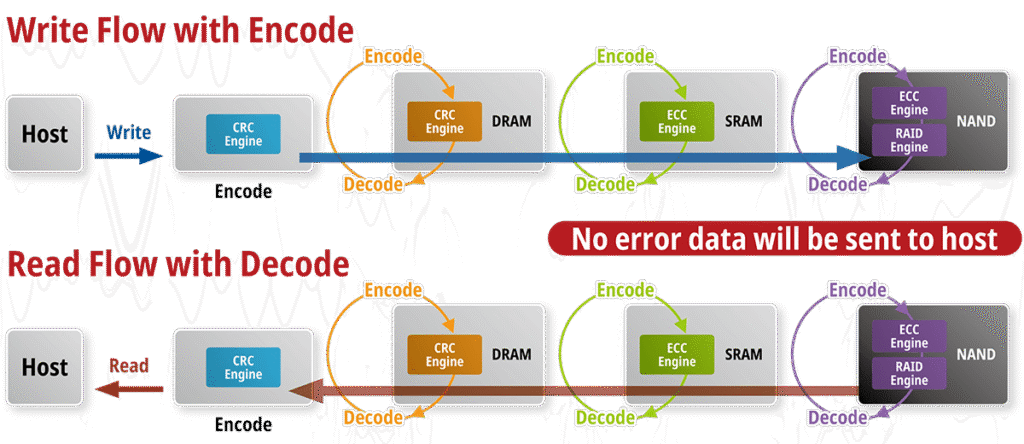
At this point it is useful to explain the mechanism that allows FerriSSD’s data recovery algorithm to immediately detect when there is an error in the data. When data is written, a set of parity bits is generated, and before reading the data, the Ferri line device will recalculate the parity bits. If the two sets of parity bits do not match, the storage device will send an error notification to the host, which will immediately start a recovery process. Traditional SSDs, on the other hand, transfer incorrect data to the host without triggering an error notification, thereby worsening the initial problem by not alerting the host to the need to start the error recovery process.
Active protection: IntelligentScan and DataRefresh
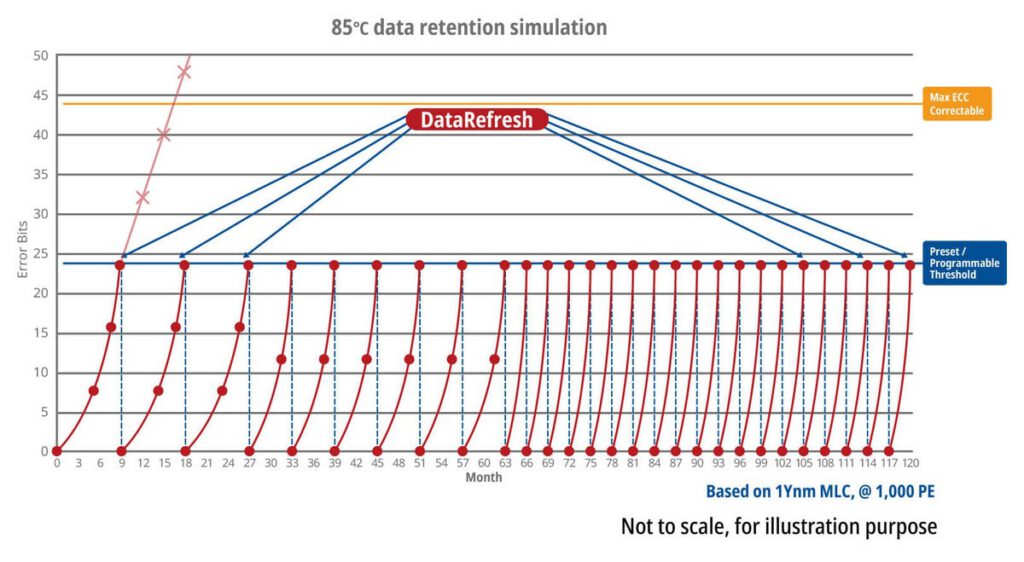
These two technologies are self-test and self-monitoring methodologies (fig. 2). Executing write and read commands on a NAND cell is essentially a process of electrical charge and discharge. Suppose a new NAND cell stores 100 electrons during a write operation. Over time, repeated write operations and erase events will help wear down the cell, reducing its capacity: for this reason the number of electrons stored during a write command can gradually decrease from 100 to 80, then to 70, then to 60, and so on. When the stored charge drops below a critical threshold, the controller will no longer be able to correctly read the data, resulting in data loss or corruption. The IntelligentScan function checks whether the stored charge has dropped below the critical threshold. If this occurs, it reads the data bits and rewrites them through the ECC engine, while DataRefresh recharges the cell to restore the NAND cell voltage to the correct level (Fig. 2).
Passive protection: NANDXtend ECC (Error Correcting Code) technology
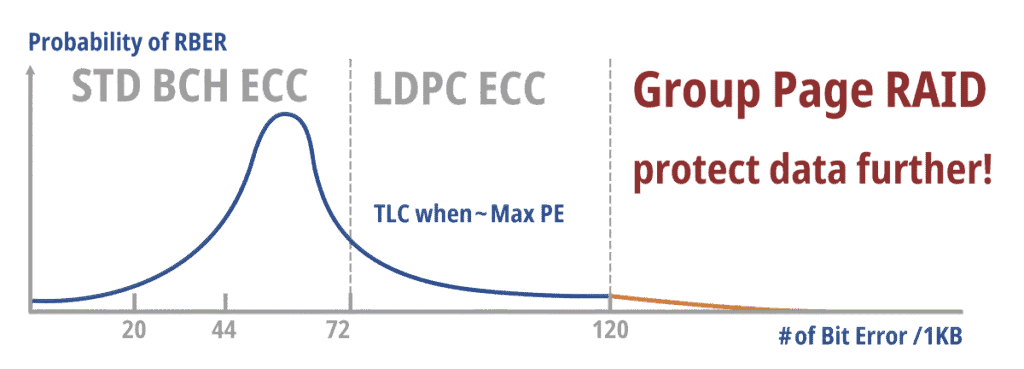
In FerriSSD products, the combination of a high-performance LDPC error correction (ECC) engine patented by Silicon Motion and the RAID function guarantees multiple advantages. First, it improves product reliability, and second, it significantly increases the number of P/E cycles, helping to extend the lifespan of the SSD’s NAND Flash memory. In addition, NANDXtend technology can help increase data storage capacity and reduce data errors attributable to high-temperature operation (Fig. 3).
User data protection
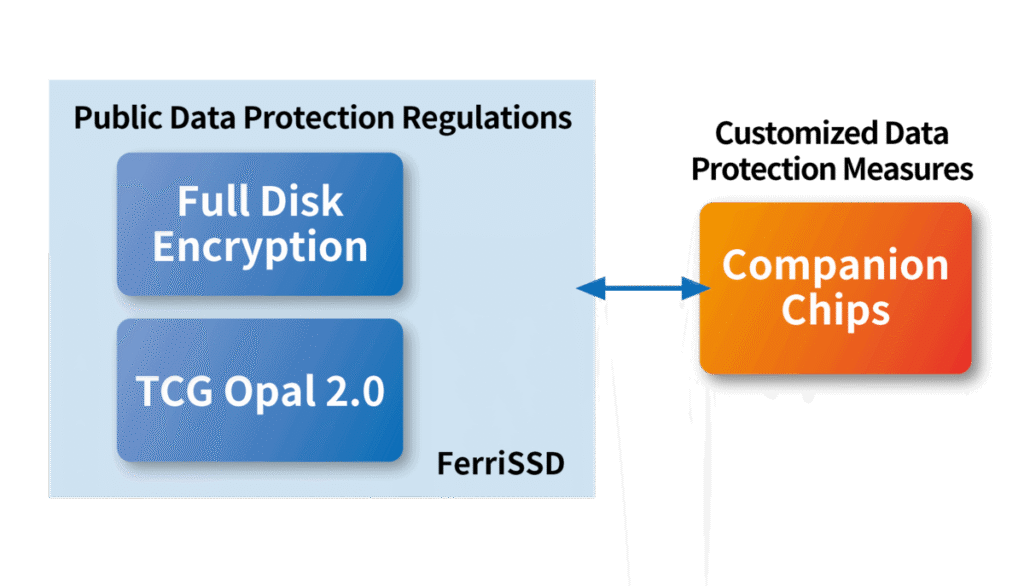
Silicon Motion has made significant investments to strengthen data protection in order to counter the risk of data compromise caused by cyberattacks. The company does not simply use its own methods or follow the standard data protection rules adopted by the market (full disk encryption/TCG Opal 2.0) as operating parameters. Customers who must guarantee high levels of protection for sensitive data often believe that the standard methodologies adopted for data security can be breached fairly easily. They therefore prefer to create their own countermeasures for data protection and security, such as adding a custom auxiliary chip (Fig. 4). This controls the flow of communication and cooperation with FerriSSD, authorizing the storage device to accept, receive or send data while ensuring the most complete protection.
Robust firmware protection with secure digital signature
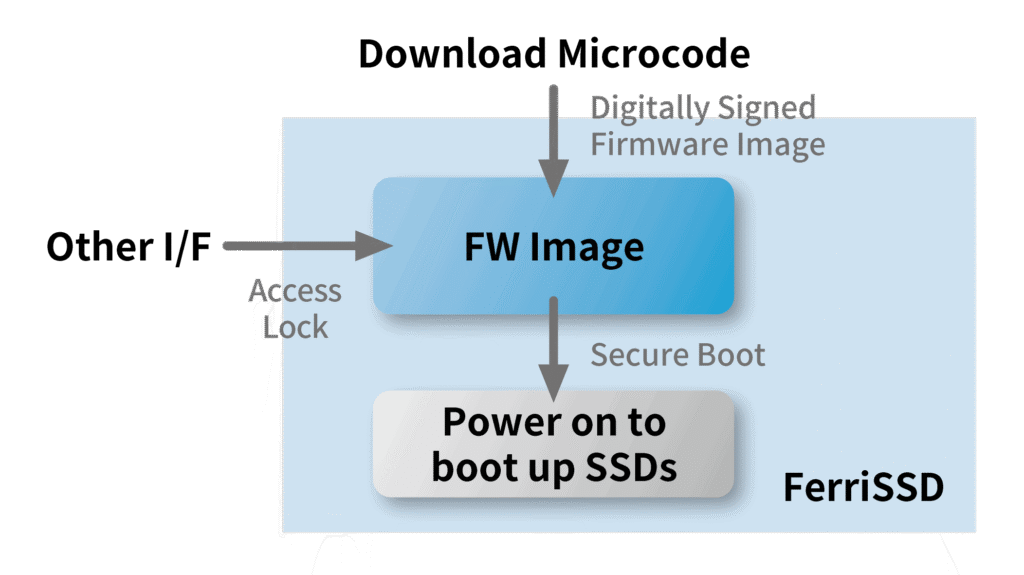
FerriSSD supports secure digital signature verification systems. This function is identical to adding a security access phrase, a procedure adopted by Silicon Motion for customers’ equipment. When the firmware is updated, it allows the parties involved to run a password verification process using the FerriSSD algorithm to produce a set of verification codes inaccessible to potential hackers (Fig. 5). If hackers were to create malicious software to force a firmware update on the final product, it would not be able to produce the verification code, and the update aimed at compromising the product would not be carried out.
Comprehensive evaluation to ensure a low dPPM
COM modules must operate over a wide temperature range, between -40 and +85 °C. Before being shipped, FerriSSD products undergo rigorous temperature testing as specified by customers (Fig. 6). This makes it possible to achieve a very low dPPM, in line with customers’ demand for products characterized by very high levels of reliability.

Ultimately, the reduction in NAND costs, the growing importance of data protection and stability, and suppliers’ desire to integrate high-value-added products into their COM boards have all contributed to the spread of BGA-package SSDs. This is particularly true for those SSD products that include data protection and features designed to ensure storage reliability.
The integration of “end-to-end” data protection and both active and passive protections for user and firmware data provides significant advantages to embedded computing systems.
Silicon Motion’s FerriSSD products have thus established themselves as the ideal storage components for embedded computing modules, thanks to the rigorous temperature testing they undergo, which guarantees very low dPPM rates. FerriSSD storage devices are the reference choice for COM products used in the military, transportation, medical, entertainment, networking, industrial automation sectors and in a multitude of other applications.
👉🏻CLICK HERE AND DISCOVER SILICON MOTION PRODUCTS!
Article published in the magazine “Selezione di Elettronica” in July 2022
Material provided by the marketing department of Silicon Motion