










































Energy storage is an integral part of our world – although often overlooked – and it is an increasingly relevant topic. Nowadays, how is it possible to efficiently store large amounts of energy, especially where the source is renewable (wind, photovoltaic)?
Likewise, the problem of energy storage is an issue we experience every day: whether it’s a smartphone, a battery-powered screwdriver or a car, many electrical devices have their own built-in energy storage unit.
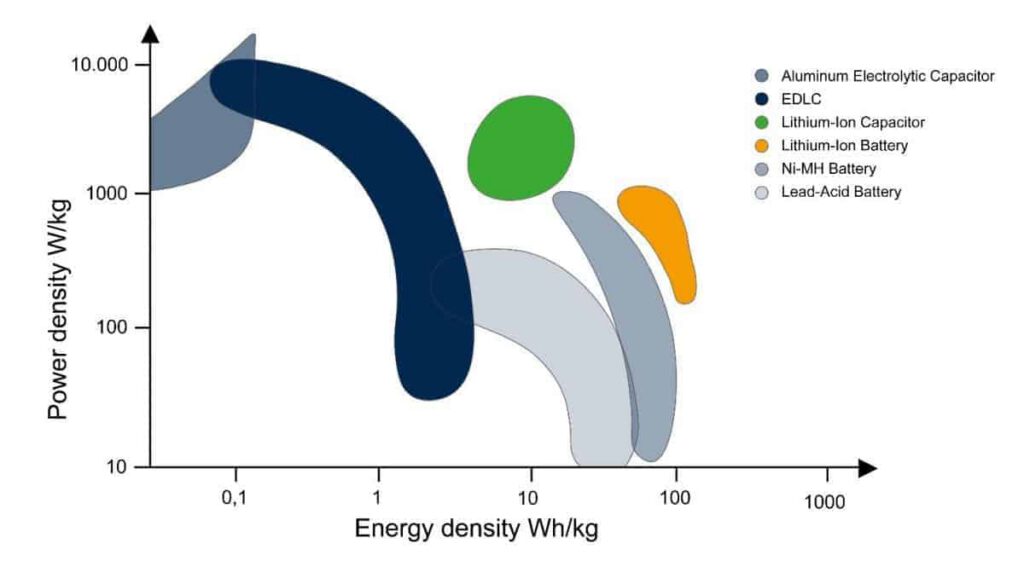
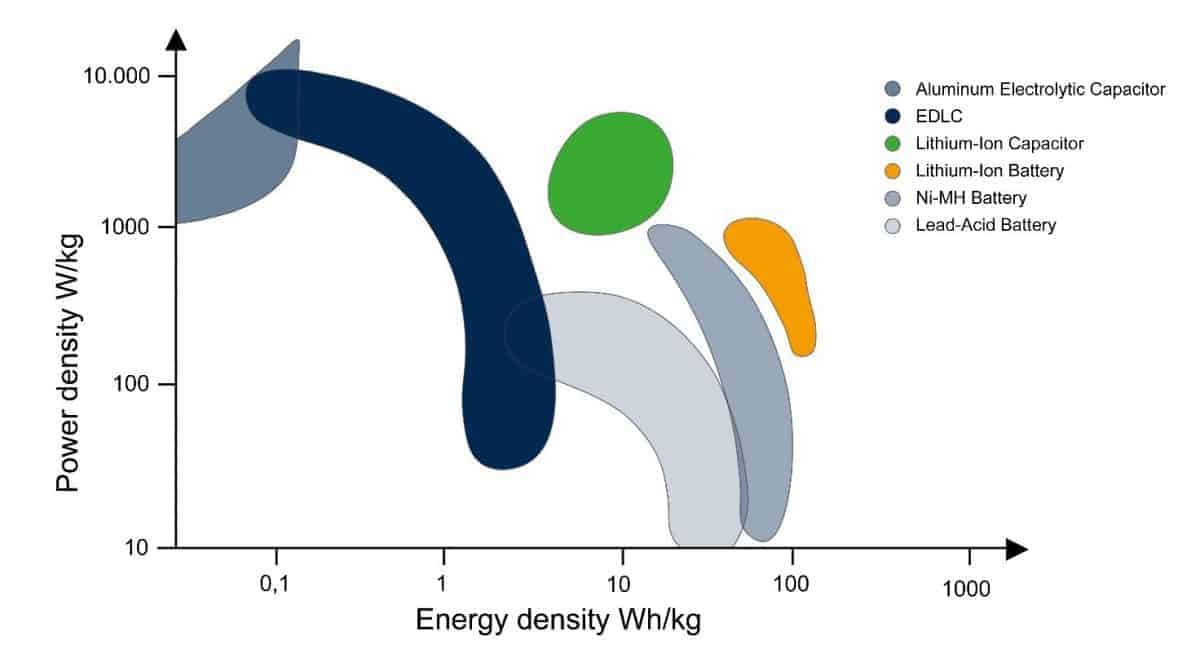
Capacitors are not necessarily the first technology that comes to mind when it comes to storing large amounts of energy; wrongly so – today more than ever – due to major innovations in the sector. Indeed, new process techniques and new formulations for creating anodic aluminum foils ensure high reliability and superior electrical performance of electrolytic capacitors, even compared to batteries. In addition, the new Energy-C (Energy-Capacitors) technology – which uses cutting-edge materials and processes – enables a storage density that was previously reserved exclusively for batteries (see Figure 1).
To better understand this scenario, we illustrate below the technical characteristics of the new solutions developed by Jianghai (a manufacturer that has always been at the forefront of capacitor innovation and is distributed in Italy by CONSYSTEM S.r.l.).
Jianghai aluminum electrolytic capacitors: the new “workhorses” of Power Electronics.
It is well known that anodic foil is, both in terms of value and technically, the most vital pre-material of an aluminum electrolytic capacitor. This material is obtained, through a two-stage process (etching and forming), from a smooth pure aluminum foil. Figures 2 (a) and 2 (b) show the cross-section of the etched high-voltage anodic foils used in in electrolytic capacitors.
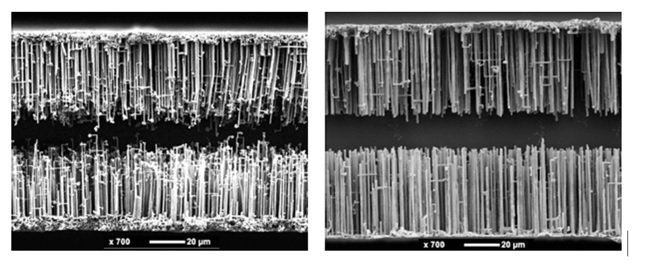
Some differences can be noted between the two figures. Indeed, thanks to its vertically integrated production system strategy, Jianghai directly manages the anode etching and structuring process, thus optimizing the film’s properties. Improvements in the etching process (Figure 2 (b)) can be seen through more uniform pores, thereby optimizing the use of the available volume. This allows for high “storage” capacitance values and more compact capacitors (especially in terms of size).
An electrochemical process creates the dielectric layer on the surface of the rough anodic foil. The quality of this “formation”, i.e. the quality of the structure and thickness of the dielectric layer, is crucial both to ensure high reliability and to guarantee “excellent” electrical performance of electrolytic capacitors in operation.
The superior quality of the high-voltage electrolytic capacitor developed by Jianghai can be seen in Figure 3.
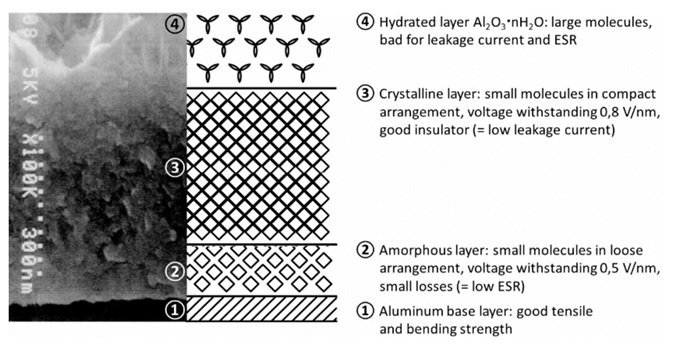
Figure 3 shows the layered structure of the dielectric in cross-section. It is composed as follows: there is the aluminum foil ① “followed” by a layer of amorphous aluminum oxide ②, then the crystal layer ③ can be seen, and finally the hydrated layer ④.
Jianghai’s new anodic films are characterized by a thinner hydrate layer and a thicker amorphous layer. As a result, the new anode films “branded” Jianghai have higher load capacities and lower ESR (Equivalent Series Resistance) values, which qualify the capacitors as ideal “workhorses” for power electronics applications.
“Energy capacitors” for the future
Since the 1950s, the largest amounts of energy have been stored in electric double-layer capacitors (EDLC). Today these capacitors are known as Super Caps, Ultra Caps, Gold Caps and/or many other commercial names (some fanciful, some not). Thanks to constant research, these capacitors have reached capacitance values of several hundred Farads, offering very high power densities (Figure 1). However, high power density capacitors – sic et simpliciter – cannot compete with recent developments in batteries and accumulators. Recently, however, a new technology has come along to shake up this scenario: “ENERGY-C” (Energy Capacitors), capable of providing a new “boost” for energy storage in capacitors! Energy-C is based on double-layer technology and its further development – by Jianghai – for mass production. Energy-C essentially uses two types of capacitors (which can be chosen according to specific needs): the classic double-layer capacitor (EDLC) and the new lithium-ion capacitor (LiC). EDLC technology, which offers a relatively high energy density and a very high power density (Figure 1), nonetheless forms the basis of both types of capacitors. Two symmetrical activated-carbon electrodes “make up” the so-called double layer of the EDLC (Figure 4 (a)). The new lithium-ion capacitor (LiC) (Figure 4 (b)) has a slightly modified design that allows for a significant increase in energy density. As can be seen, a lithium-doped graphite electrode replaces one of the two symmetrical electrodes. The asymmetric construction of this lithium-ion capacitor (LiC) allows for a much higher energy density, but at the same time has a lower power density compared to the EDLC (Figure 4 (a)). Both constructions have their own particular strengths that make them ideal solutions for different applications. In terms of energy and power density, the lithium-ion capacitor (LiC) sits between the double-layer capacitor (EDLC) and the Li-Ion battery (LiB) (Figure 1).
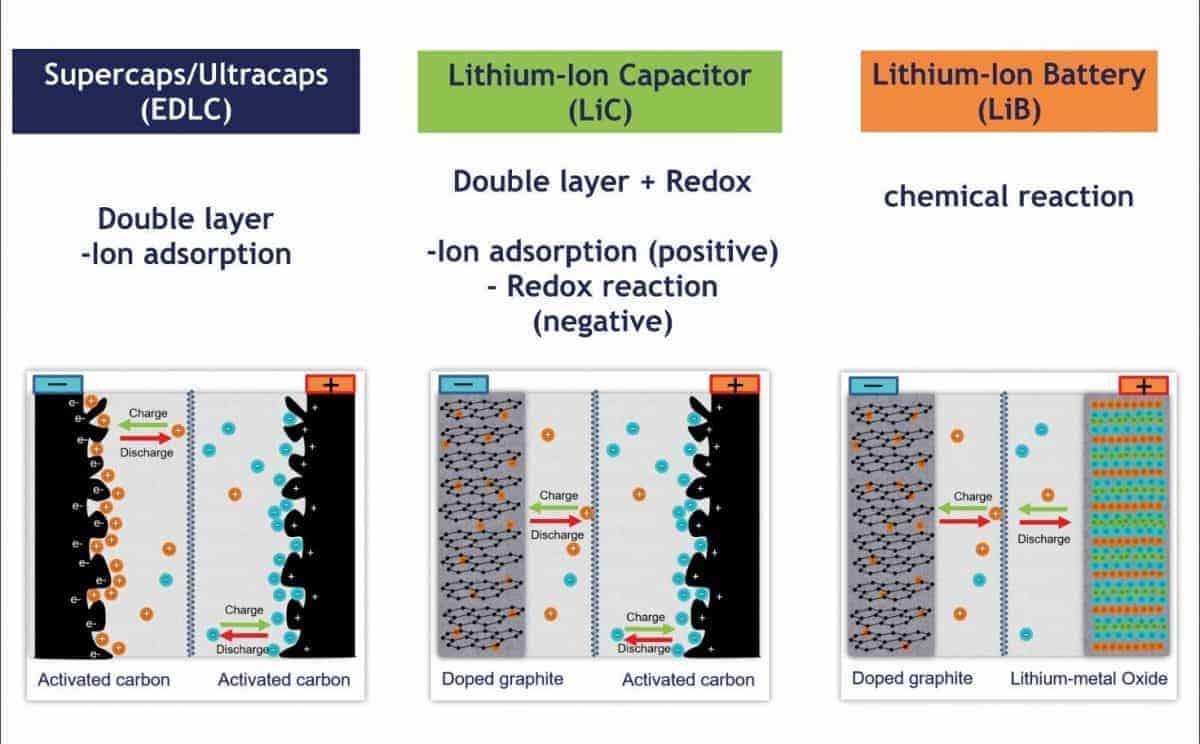
Figure 4 (b) shows that the LiC has an EDLC electrode (activated carbon) and a LiB electrode (doped graphite). As a result, the lithium-ion capacitor (LiC) approaches the energy density of batteries. However, the fast charge/discharge advantage is retained. This allows numerous charge cycles within a range of just a few minutes. However, for applications requiring even faster charge and discharge cycles, the EDLC is still the best choice. In addition to charging times, there are other “interesting” arguments in favor of using the new Energy-C technology compared to traditional batteries, as follows:
In terms of cycle stability and lifespan
Energy-C capacitors are far more “advanced” than batteries. Lithium-ion batteries offer (only) around a thousand cycles, the LiC reaches several tens of thousands of cycles, not to mention that double-layer capacitors can boast even higher values, guaranteeing charge and discharge cycles numbering in the many hundreds of thousands.
Stability and charge retention even at high temperatures
The technological design and combination of materials used in the lithium-ion capacitor ensure excellent stability and charge “retention” even at high temperatures. Indeed, while accumulators and the LiC remain stable at room temperature (discharging less than 5% over a lifecycle of about 2500 hours), an EDLC already loses 30% of its charge after 2000 hours. At 60°C, the discharge rate of an EDLC increases significantly due to the “accelerated” chemical reactions between the supporting electrolyte and the electrode material. The consequence of these chemical reactions is greater current leakage, which normally leads to charge loss in both batteries and EDLC capacitors. The lithium-ion battery loses up to 30% of its charge after 2500 hours of operation, whereas for EDLCs this phenomenon occurs after just 500 hours. In energy harvesting applications, the Li-C undoubtedly offers very significant competitive advantages.
Safety and reliability
The LiC is just as safe as an EDLC, thanks to the particular process that firmly incorporates lithium ions into its carbon-based molecular structure (“doping”). Unlike lithium batteries, no elaborate designs or engineering are needed to reduce the risk of thermal runaway and the consequent risk of fire. Thanks to doping, the LiC capacitor contains neither metallic lithium nor lithium oxide. The doping method therefore allows the capacitor to remain safe at all times, even in the event of mechanical damage, high temperatures or “heavy” electrical discharges.
Better environmental footprint and usability
Producing a LiC requires less than 3% of the amount of lithium needed for a LiB capacitor of the same volume. Beyond ensuring better use of resources and greater respect for the environment, this feature also translates into lower weight and more compact dimensions.
New technological horizons
The Energy-C concept represents a new technological frontier for energy storage (both for existing and future applications). Indeed, beyond everything listed above, there is further potential yet to be discovered for this technology. In the future, energy densities of 50 Wh/kg and power densities above 30 kW/kg should be achieved. Jianghai is leading research into new electrode materials, which should further increase conductivity while expanding the component’s temperature range and at the same time increasing its temperature stability. In summary, it can be seen (as shown in the Ragone diagram (Figure 1)) that lithium-ion capacitors open up a new scenario and a new range of applications that were previously covered by neither batteries nor other capacitors! All the capacitors described here are already mass-produced by Jianghai and have demonstrated their superior performance under real operating conditions in the field, and are supplied in Italy by CONSYSTEM S.r.l. as a long-standing, trusted distributor.
See all capacitors here