Passenger cars: 1.2 million PHEVs, 6.3 million BEVs, 0.75 million e-LCVs, 0.05 million e-HCVs and 0.07 million e-BUSes for local public transport
Electricity system: a system with 100 GW of RES capacity (75 GW from photovoltaic and 26 GW from wind), storage capacity of 15 GW with an energy-to-power ratio of about 6
hours, and electricity demand between 362 and 366 TWh/year.
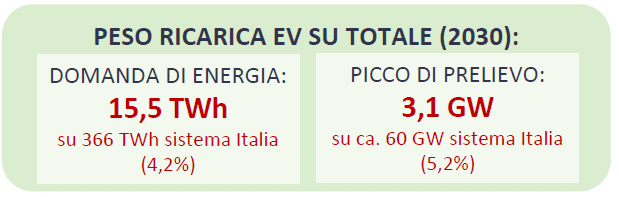
The study conducted shows that, by 2030, the development of e-mobility is sustainable together with the evolution of the grids according to the FF55 plan, with an impact below 5%.
However, some issues emerge that highlight the importance of the widespread adoption and use of V2G and VGI.
The results showed an increase in the maximum load factor of grid elements due to vehicle charging, with greater issues related to short-duration but significant overloads for elements at lower voltage levels.
In this scenario there is a very important issue – the impact of charging related to overload phenomena (brief and intense) – which places a strong focus on the topic of grid bidirectionality and “dispatching” through the enablement of electric vehicles.
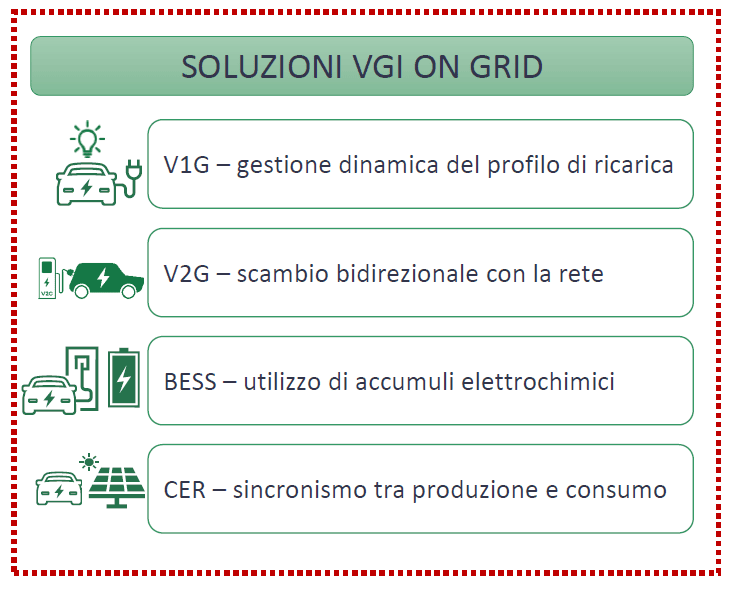
Possible VGI solutions include smart charging practices and appropriate synchronization between generation, storage and charging.
VGI solutions aim to make charging smarter, smoothing out demand peaks and making it more consistent with generation profiles from non-programmable sources. This type of result is often achievable even just through V1G practices, i.e. simple charging control. Furthermore, it is also possible by considering the use of storage or more complex V2G solutions, which make it possible to achieve smart charging profiles even in the (minority of) situations that cannot be resolved with V1G alone.
Indeed, according to the study, enabling electric vehicles makes it possible to reduce “overgeneration” by 45% (equal to 2.5 TWh/year), also contributing 15% of the total procured reserves and 26% of the transactions carried out for system balancing.
In addition, an analysis was carried out of the economic advantages for charging operators thanks to V2G (Vehicle to Grid) and Vehicle-Grid Integration (VGI).
These enablements would make it possible to reduce the peak and slow down the morning load ramp, synchronizing energy consumption with renewable production and ensuring greater consumption during daytime hours.
Main benefits / key findings
Leveraging electric vehicles under charge for dispatching makes it possible to halve (-45%) the photovoltaic overgeneration linked to the system scheduling phase carried out in the ex-ante MSD
Electric vehicles play a central role in dispatching markets, making significant volumes of reserves available (15%) and contributing to service provision (26%)
The economic benefits of VGI on dispatching amount to €800 million per year, reducing MSD costs by 40%, thanks to a charging profile naturally suited to reserve provision
Charging profiles are naturally suited to reserve provision, without the need for large ex-ante transactions, and the sensitivity analysis on offered prices highlights opportunities for fair revenues for electric vehicles while still ensuring benefits to the system.
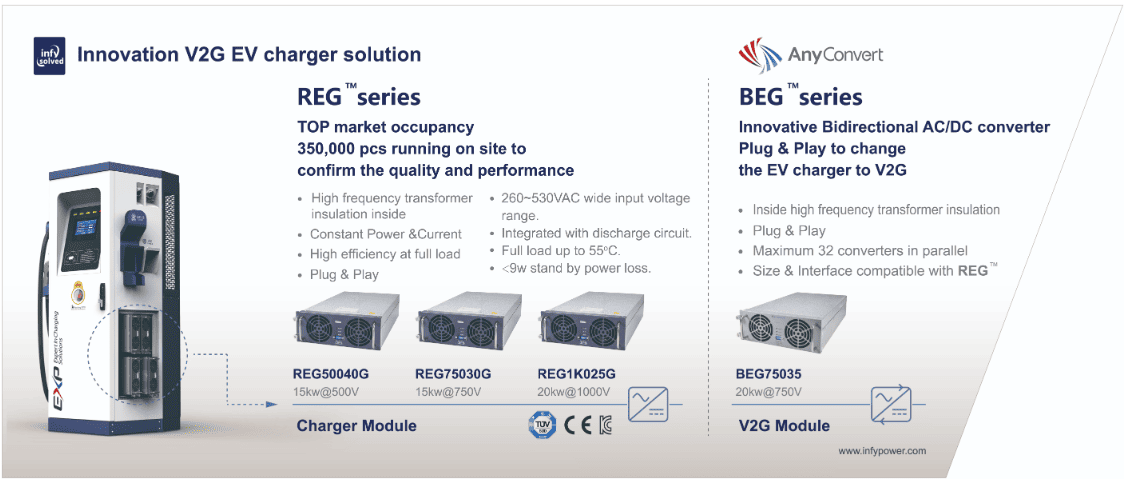
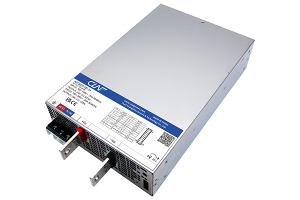
CONSYSTEM intends to promote the spread and implementation of this technology by offering electronic components specific to EV chargers.
In particular, bidirectional power modules developed by a technology partner specialized in the field with a strong focus on R&D: INFYPOWER
👇 Discover the technology offering and products! 👇